The Road Beneath the Grades
20 min readThe Road Beneath the Grades
A home that runs a different operating system
Here’s a claim that will sound arrogant to some parents and impossible to others:
School should feel easy.
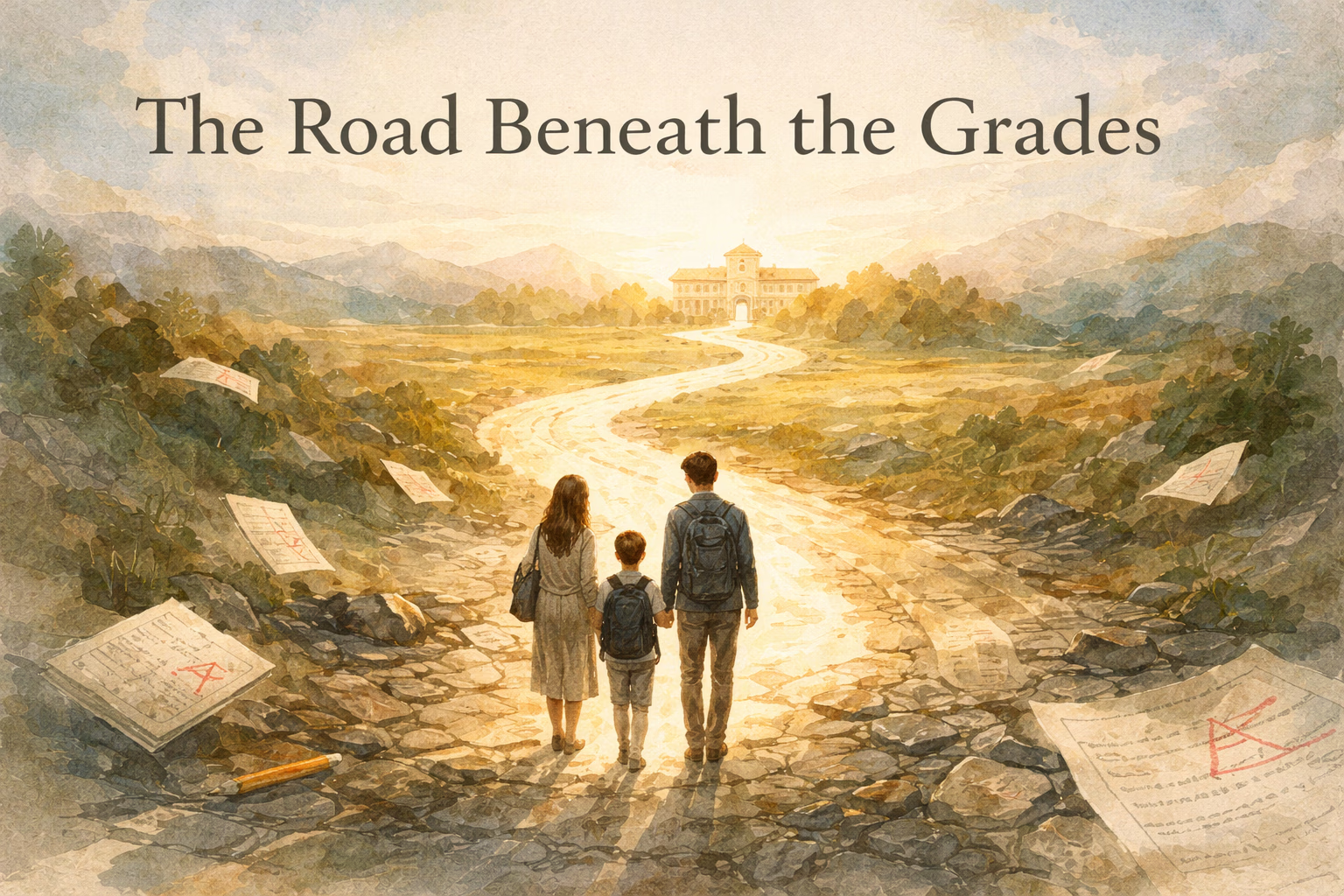
Not “effortless.” Not “always fun.” Easy in the sense that the basic act of learning—reading, reasoning, practicing, making mistakes—should feel like a road you can drive on, not a swamp you have to crawl through.
Honestly, if the opportunity arises, I should expose the sheer absurdity of the entire education industry—public and private alike.
I say this as a teacher in China with a Western education, which means I have the privilege of being confused in two different ways. I’ve watched the social logic around children become… elaborate. Competitive. Sometimes deeply unkind. The incentives are strange. The pressure is everywhere. The performance never ends.
I don’t expect an essay to dent a culture. I’m aiming smaller than that: a family of three. A home that decides, deliberately, to run a different operating system.
Because if textbook-level material wasn’t designed to be absorbed by most human brains, then what did we build? A twelve-year obstacle course we mandate every child to run, knowing most will fail?
That’s a different essay.
You aren't actually mulling over an IQ test now, are you? Please, do me a favor and stop reading.
Assuming the curriculum was built for 100 IQ humans, a persistent struggle to learn usually isn’t proof the work is too hard. It’s evidence the learner’s internal system is compromised.
A healthy child—mentally safe, emotionally steady, physically rested—has no good reason to be unable to pick up age-appropriate material. The human brain is built to learn. Curiosity is the factory default. When a kid stares at a math problem and “can’t do it,” adults tend to reach for two explanations:
Not smart enough.
Not disciplined enough.
We’re often wrong.
It’s an infrastructure problem.
We treat mental health like maintenance—something you fix after it breaks. But mental health isn’t the tire. It’s the road. It’s the underlying infrastructure that makes learning possible. And if the road collapses, it doesn’t matter how powerful the engine is. You’re not going anywhere.
The “Fine” Fallacy
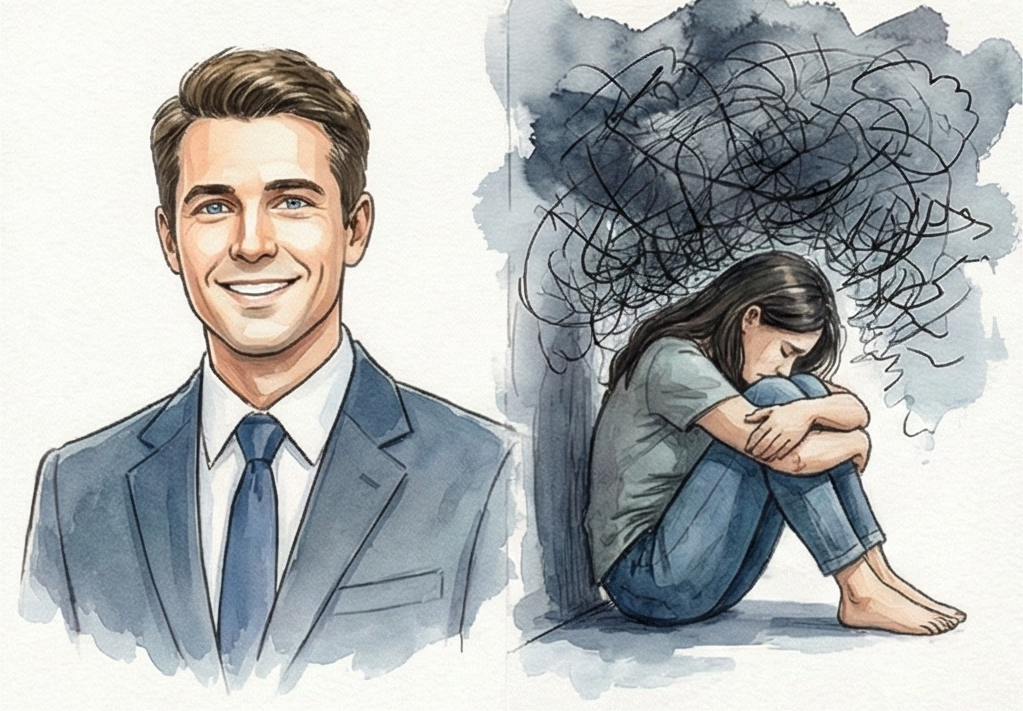
Whenever I say this out loud, a certain voice shows up—often from someone who grew up in a high-pressure environment:
We were pushed hard. We turned out fine.”
YOU SUB IQ PIECE OF DEGENERATE SCUM
I have a complicated relationship with that sentence.
Because the honest reply—the one people bite back because it’s socially impolite—is: I don’t think “fine” is what you mean.
Oh I'm being so fucking polite here
I respect endurance. I respect survival. But I also notice the cost: the inability to rest without guilt, the constant hunger for validation, the anxiety that wakes you up at 3 a.m., the internal noise you’ve learned to mask as “normal adulthood.”
You survived, yes. But why are we aiming for endurable as the ideal state for our children?
Why is “not broken” the goal instead of “actually thriving”?
If culture is a machine, “fine” is often the output it asks for: functional enough to perform, numb enough not to complain. In other words: useful.
But children are not meant to be optimized into usefulness. They are meant to bloom into aliveness.
Threat Is a Learning Killer
The science here is cold and boring—in the way true things often are:
You can’t learn well under threat.
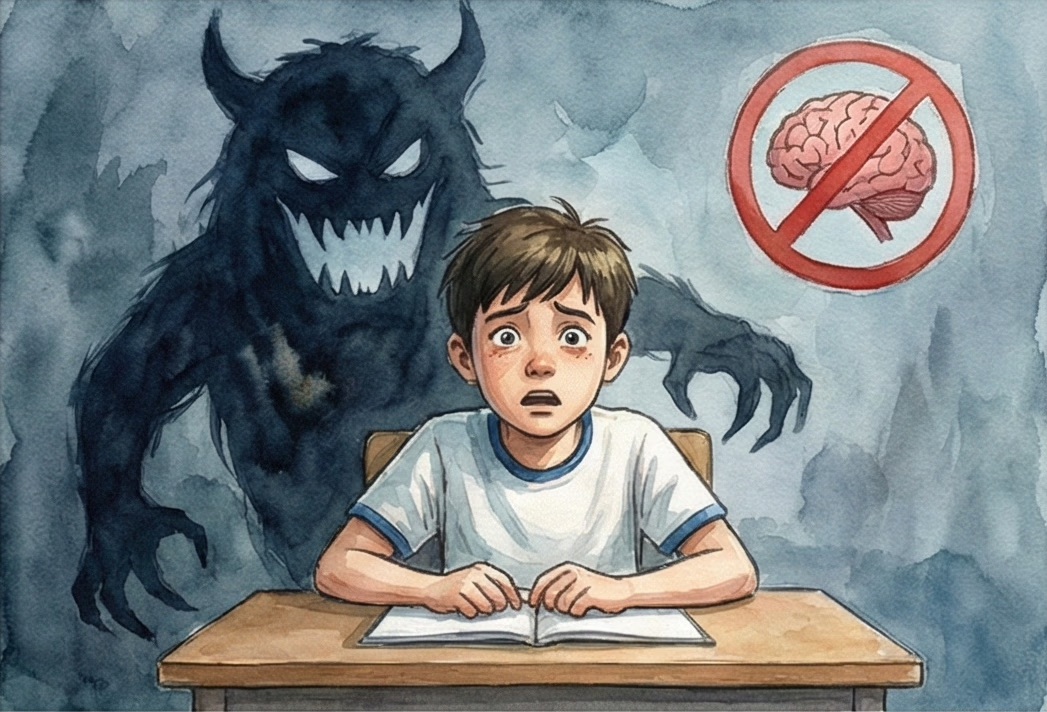
When a student is afraid—of failure, of looking stupid, of disappointing parents—the brain shifts priorities. Attention narrows. Working memory (your mental scratchpad for solving problems) gets occupied by vigilance. The brain doesn’t become “lazy.” It becomes busy—running a background process called “don’t die socially.”
So if a kid’s working memory is 90% filled with anxiety, they don’t have enough left for Algebra. They aren’t “bad at math.” They’re cognitively suffocating.
And under sustained pressure, something worse happens: the brain stops doing flexible learning and starts doing survival learning—memorizing, pattern-matching, performing. Not understanding. Not exploring. Just getting through the moment.
That’s how you create students who can recite, but can’t think.
If you want a society that can innovate, you don’t train children to fear mistakes. You train them to metabolize mistakes. That requires safety. Safety is not softness. Safety is the precondition for growth.
Adolescence: The Invisible Weight Class
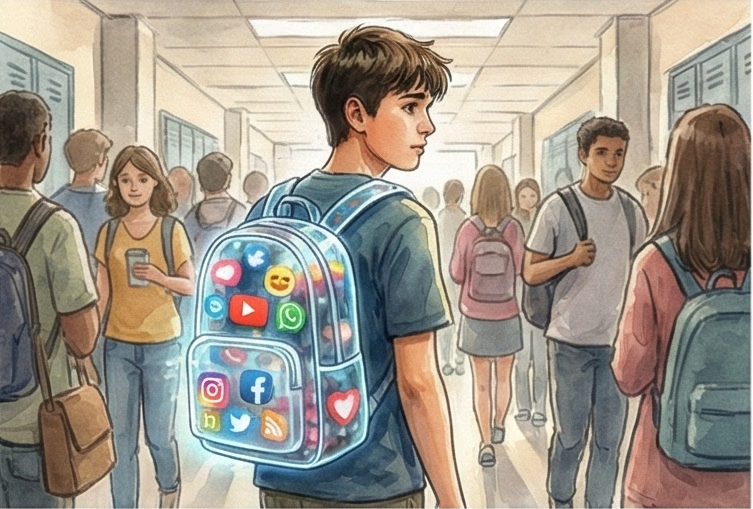
This becomes tragic during adolescence because the threats get invisible to adults.
Parents assume kids are stressed about the big, rational things: exams, college, the future.
But adolescence is not a spreadsheet. It’s a raw nerve.
This is the stage of life when sensitivity to social evaluation peaks. Tiny signals become enormous: a weird laugh, a cheap pair of shoes, a haircut that went wrong, a teacher’s tone, a friend’s pause before replying. These things can eat a teenager’s entire mental bandwidth.
To an adult, your tone when you ask “How was school?” is trivial.
To a teenager, it can feel like a courtroom.
And in China, this “courtroom feeling” often isn’t just an adolescent phase—it’s a cultural atmosphere. Face, ranking, comparison, indirect judgment. Sometimes love itself gets translated into pressure because pressure is the language the system speaks.
But teenagers don’t experience “pressure” as language. They experience it as threat.
And the cruel part is that the content doesn’t matter. The child could be under crushing pressure simply for being different—and in the twisted logic of adolescence, what makes them different is almost irrelevant.
They might just want to blend in. So even a very wealthy family can become a source of shame. To you, the big apartment is success; to them, it’s a spotlight. A reason people whisper.
Any readers sitting on billions who refuse to play this game? Email me a selfie right now. I'll pay you exactly 420 bucks.
Weird? No. At fourteen, social survival is the main currency. Not your net worth. Not your career plans for them. Social survival.
So while they’re fighting a high-stakes internal battle against embarrassment, rejection, and identity panic, we’re yelling about homework. We see “lazy.” They are living through a horror movie where the monster is “being perceived.”
The Trap of Negative-Value Effort
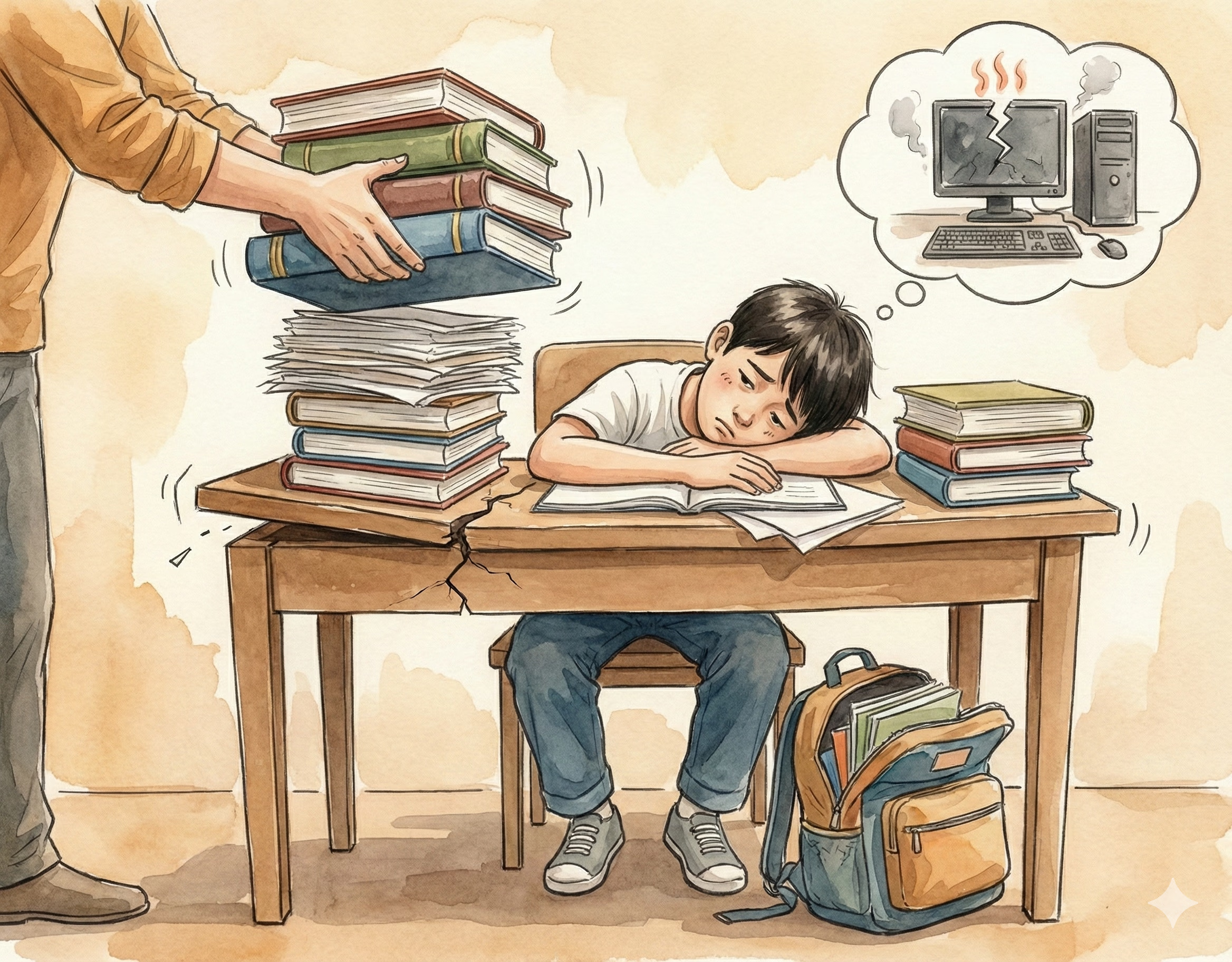
When adults see a child struggling under invisible weight, the instinct is to push harder.
More tutoring. More lectures. More monitoring. More “accountability.” More pressure.
In a culture that worships results, this feels responsible. It feels like love. It feels like doing your job.
But if the system is already overloaded, adding load doesn’t build strength. It causes collapse.
I call this negative-value effort.
It’s like trying to fix an overheating computer by running more demanding software. You might squeeze out short-term performance, but you’re cooking the hardware.
Yes, you may win the battle for an A.
But you can lose the war for their mind.
And then, later, we act surprised when the child “suddenly” hates learning, hates school, hates themselves, hates you. As if the nervous system didn’t keep receipts.
A Proposal: Build the “Strong Heart” First

What if we flipped the default setting?
What if psychological development wasn’t treated as a byproduct of growing up, but as something we train intentionally—like literacy, like strength, like coordination?
Because the highest ROI for a parent usually isn’t another math class.
It’s a stronger heart.
Build the infrastructure before you drive the heavy trucks of calculus and physics over it.
This is where my cynicism and my hope meet.
My cynicism says: the broader system will not stop rewarding performance anytime soon.
My hope says: a family is a small system. Small systems are governable.
A family can decide to be a shelter instead of a second battlefield. That’s not a revolution. It’s something rarer: it’s control.
The Family as a Dojo
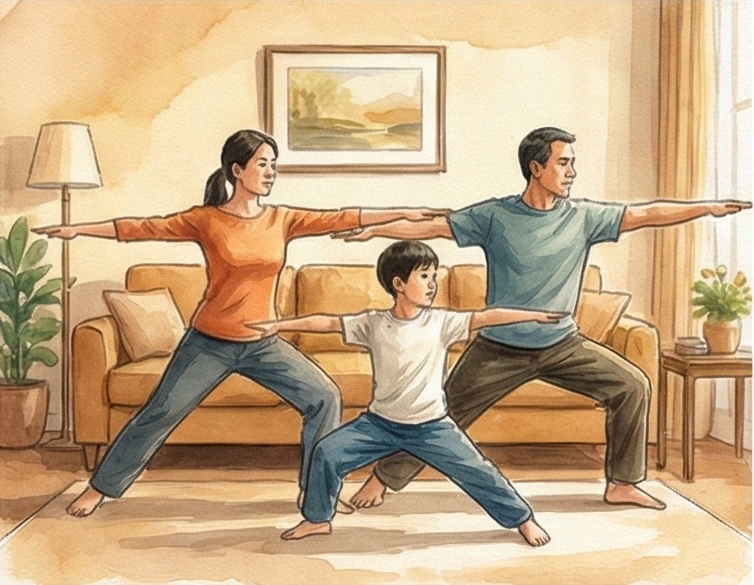
The goal isn’t to shield kids from difficulty. The goal is to let them face difficulty in a controlled, loving environment—so their nervous system learns: “This is hard, and I can handle it.”
Family gatherings are a perfect training ground. They feel high-stakes (everyone’s watching) but have low-stakes consequences (these people love you). That’s exactly the environment in which confidence is built.
Tool 1: Scripted Scenarios
Don’t just let them disappear into iPads. Design small challenges.
Shy kid? Script a moment: “Before we eat, Leo is going to make a toast.”
He stands up. His heart races. He stammers out three sentences.
What? Is your relationship too broken to facilitate such a calculating little move? Oh well, go listen to the song.
Then something crucial happens: nobody critiques. Nobody “helps him improve.” The adults applaud like he just landed a plane.
You just hacked his system.
Oh, and please—none of that plastic, transparent encouragement characteristic of corporate drones. What? You can't do that? WTF... you fucking...
His brain felt pressure, faced it, survived it, and got rewarded. That’s not empty praise. That’s nervous-system training. That’s building a road.
Tool 2: The Moral Ambiguity Lab
Scripted scenarios train behavior. Conversation trains interpretation.
And I don’t mean “How was school?” followed by “Did you finish your homework?”
I mean talking about the grey, terrifying parts of being human:
What do you do if your best friend cheats on a test?
Is it better to be kind or to be right?
When do you stay loyal, and when do you walk away?
And then, sometimes, go first:
I felt insecure today when someone critiqued my work. Have you ever felt that when a teacher calls on you?
When you normalize these inner battles, you give your child vocabulary for their pain. You show them insecurity isn’t a defect—it’s a human condition.
If they can talk about it at the dinner table, it won’t paralyze them in the classroom.
The Prerequisite: The Mirror Test
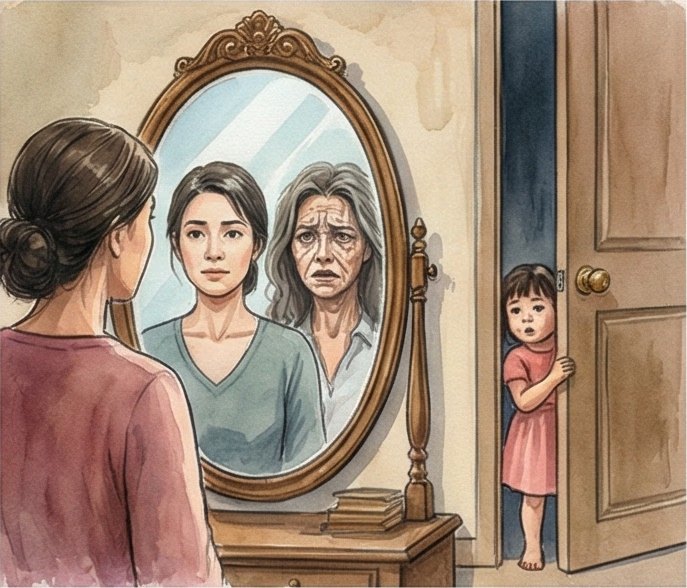
Before you try to “teach resilience,” we have to address the uncomfortable part:
You can’t teach what you don’t possess.
If you want a strong heart in your child, you need to look in the mirror.
1) Face your own pressure system.
If you crumble under judgment, hide failures, and live on validation, your child won’t absorb your advice. They’ll absorb your energy. Kids don’t copy what you say. They copy what your nervous system does under stress.
If you want a brave child, you must become the kind of adult who can be seen failing without collapsing.
2) Stop using “manager language” at home.
Modern parents let workplace thinking hijack family life: efficiency, results, optimization, KPIs.
Stop it.
Efficiency is a value for machines, not for human souls. When you talk to a child like an employee, you’re not parenting—you’re conducting a performance review. And you’re feeding the exact threat state that blocks learning.
Home should not feel like the office. Not because life isn’t serious—but because children are not employees. They are becoming.
3) Hold boundaries without using control.
Boundaries keep people safe and respectful. Control tries to force a child to become who you want.
Those are different species.
Your job isn’t to be their boss. Your job is to be their spotter at the gym: you let them lift the heavy weight, you let them struggle, and you keep the weight from crushing them.
Supportive parenting buffers stress. Controlling parenting amplifies it. This isn’t moral philosophy; it’s mechanics.
The Soul of the Matter
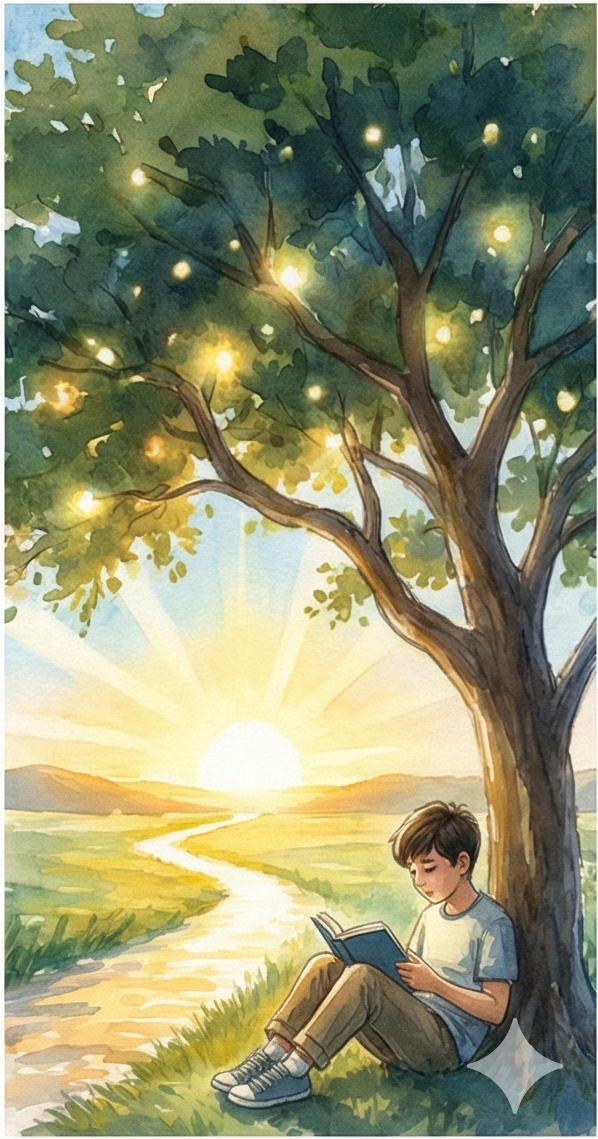
Observe your child. Predict their heart. That’s the job.
Not just checking grades, but noticing what invisible whispers are haunting them in the hallway. Not just “Are you doing your homework?” but “What are you carrying that makes homework feel impossible?”
Because when a kid with a trained heart walks into class and gets hit with a hard question, they don’t freeze.
Their infrastructure is solid. Their working memory isn’t occupied by war. Their mind has room.
They have no reason not to learn, because they aren’t fighting themselves.
And this is the part I will say plainly, even if it sounds utopian: when the infrastructure is healthy, school becomes what it was always meant to be.
Not a torture device. Not a sorting machine. Not a stage.
A place where a human brain does what it naturally does.
Learn.
Stop patching cracks. Rebuild the foundation. Build the road.
If we can’t change the entire culture, we can still change the smallest culture that matters: the one a child lives inside every day.
A family.
A home that runs a different operating system.
Good Luck.
And in that home—quietly, stubbornly, almost rebelliously—school starts to feel easy.